
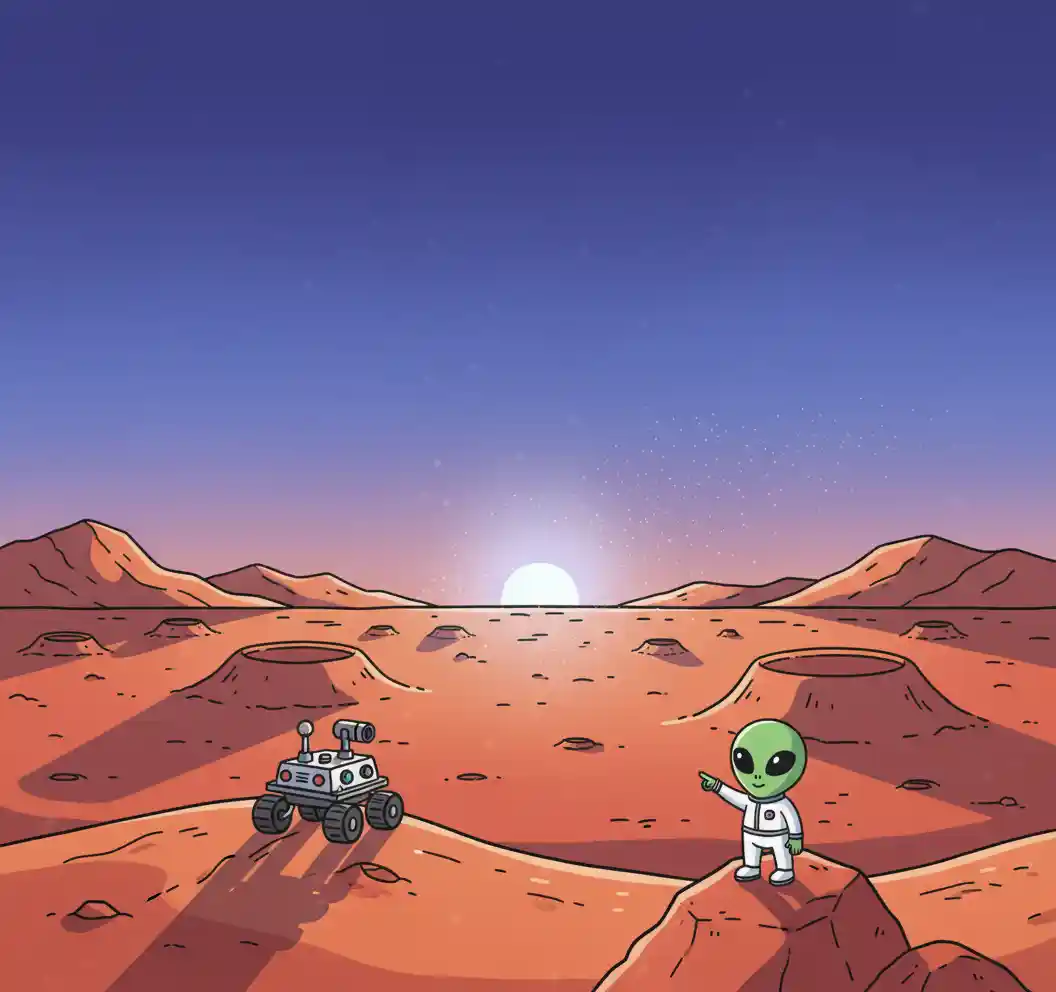
A Different Kind of Sky
On Earth, we are used to a blue sky during the day and a beautiful red or orange glow at sunset. If you were an astronaut standing on Mars, you would be very confused. The Martian sky during the day is a dusty, pale orange or 'butterscotch' color.
But when the Sun begins to set on the Red Planet, something magical happens. The area around the Sun turns a cool, ghostly blue. It is a 'bizarro' version of Earth’s sunset.
The Scattering Secret
To understand the blue sunset, we have to look at how light moves through air. This is called 'scattering.' On Earth, our air is made of tiny gas molecules that are great at scattering blue light everywhere, which is why our daytime sky is blue.
On Mars, the atmosphere is very thin and filled with fine dust particles. This dust is made of iron oxide (rust). During the day, this dust scatters the red part of the sunlight, giving the sky its orange-red tint.
Size Matters
The dust particles on Mars are much larger than the gas molecules on Earth. The size of this dust is 'just right' to allow blue light to pass through it more easily than other colors.
As the Sun sets, the light has to travel through a much longer path of the atmosphere to reach your eyes. By the time the light gets to you, the red light has been scattered away by the dust, but the blue light makes it through, creating a blue halo around the Sun.