
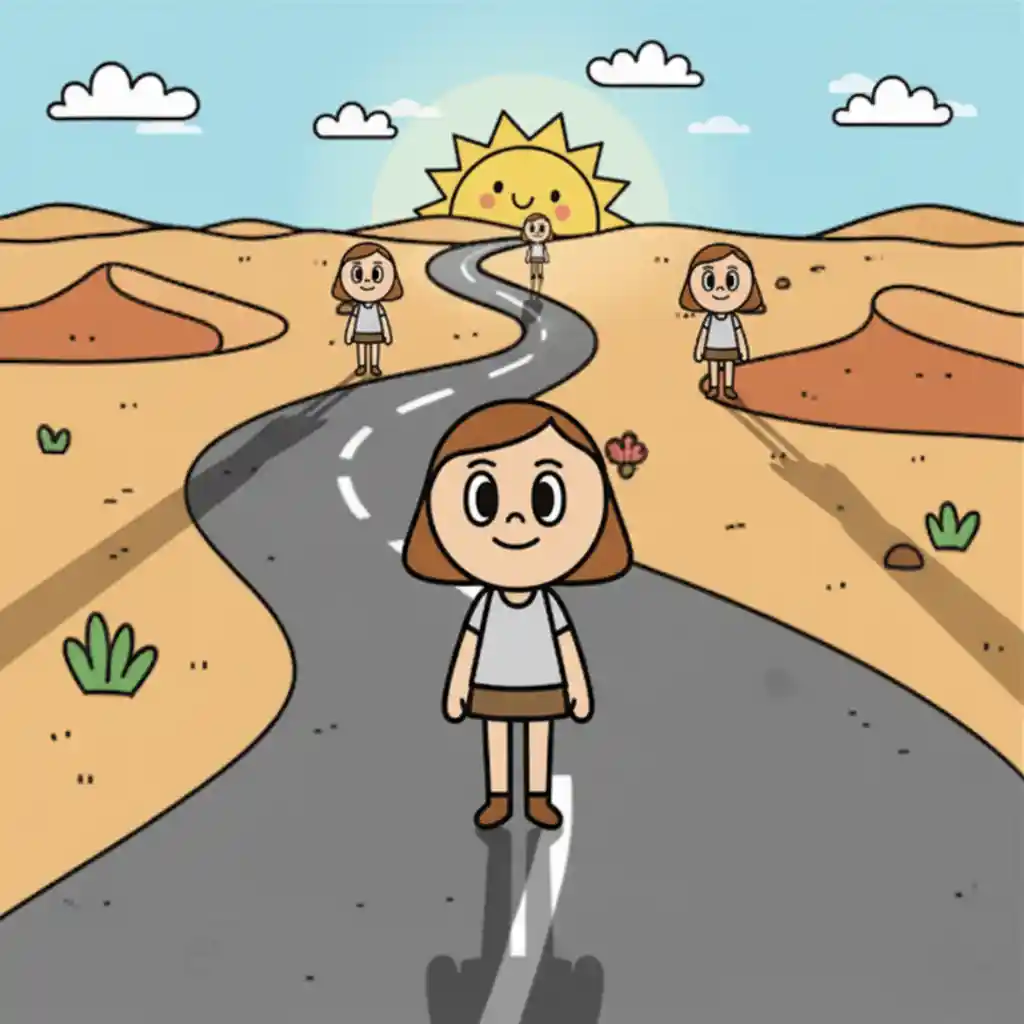
The Light Blocker
Light is like a tiny army of glowing arrows traveling in perfectly straight lines. Because light can't curve around you, your body acts like a wall. The dark spot on the ground behind you is simply a 'no-light zone' where those arrows were blocked by your solid body.
The Angle Trick
Think of a flashlight: if you shine it from the side of a toy, the shadow is long. If you shine it from directly above, the shadow is tiny. During the day, the sun 'moves' across the sky, changing the angle it hits you. Low angles in the morning and evening make long shadows, while high angles at noon make short ones.
Point of Origin
The size of a shadow also depends on how close you are to the light. If you stand very close to a lamp, you block a larger 'slice' of the light's path, making your shadow look like a giant on the wall. As you move further away, you block less of the light's spread, and your shadow shrinks back to a normal size.
Fuzzy Edges
Have you noticed that some shadows are sharp while others are fuzzy? This happens because of the size of the light source. A tiny LED creates a crisp edge, but a big light (like the sun or a frosted lightbulb) peaks around your edges from different sides, creating a soft, blurry border called the 'penumbra'.
Bending Shadows
Shadows can look strange when they fall on bumpy surfaces. Because light travels in straight lines, a shadow will 'bend' over a curb or climb up a wall. It is essentially a 2D projection of your 3D shape being draped over the world like a dark piece of fabric.
The Colors of Shadow
While we think of shadows as black, they often have a hint of color. On a sunny day, shadows on the ground can look slightly blue. This is because the 'no-light zone' is blocked from direct yellow sunlight, but it is still being lit by the blue light scattering from the rest of the sky.
Transparent Shadows
Not everything makes a dark shadow. Transparent objects like glass or clear plastic let most light through. However, they still bend the light (refraction), which creates beautiful, bright, dancing patterns called 'caustics' on the ground instead of a traditional dark shadow.