
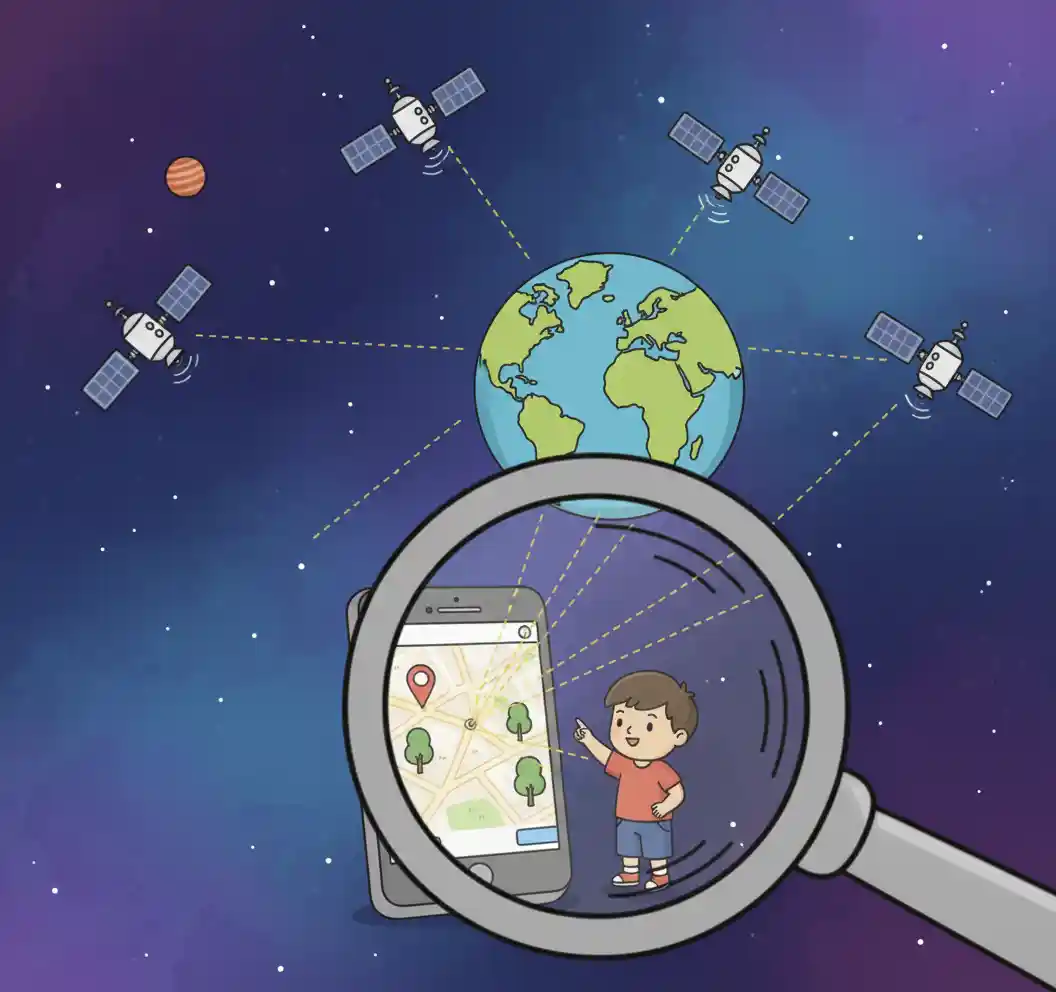
Your Invisible Navigator
Have you ever been on a car trip and wondered, 'Are we there yet?' or maybe lost your way trying to find a friend's house? Luckily, we have a super-smart system that helps us find our way almost anywhere on Earth! It's called GPS, which stands for Global Positioning System. Think of it as your own personal, invisible navigator, always ready to tell you exactly where you are and where you need to go.
But how does your phone, or your car's navigation screen, magically know your spot on the giant map of the world? It doesn't have a tiny explorer inside! The secret lies high above us, zipping around Earth in space. A team of special helpers, called satellites, are constantly broadcasting secret messages. Your phone is like a super listener, picking up these messages to create a 'space map' just for you!
A Team of Stars in the Sky
Imagine Earth is a giant playground. High above this playground, about 12,000 miles (20,000 kilometers) away, a 'constellation' of GPS satellites is always circling. There are usually at least 24 of them, but often more, like a giant team working together. Each satellite is like a tiny, glowing star that does one very important job: it sends out a special radio signal, all the time, every single second.
These satellites aren't just floating randomly; they're in very precise orbits, like cars on invisible racetracks in space. This means at any given moment, no matter where you are on Earth (even in the middle of a huge ocean or a vast desert), you can usually 'see' (meaning, your device can receive signals from) at least four of these amazing space helpers. They are your eyes in the sky, ready to guide you.
The 'Listen & Time' Game
So, how does your phone use these signals? Your phone doesn't send a signal to the satellites; it just listens. Each signal from a satellite contains two super-important pieces of information: first, exactly what time the signal left the satellite, and second, exactly where that satellite was in space when it sent the signal. It's like receiving a postcard with a time-stamp and the sender's address.
Your phone listens to signals from several different satellites. It knows the exact time it received each signal. Since radio signals travel at a known speed (the speed of light!), your phone can figure out how long each signal took to reach it. Just like if you hear thunder after lightning, the longer the delay, the further away the storm. By measuring the travel time, your phone can calculate exactly how far away it is from each satellite!
Why Four is the Magic Number
You might think, if I know how far I am from one satellite, that's enough, right? Not quite! If you know you are 10 miles from a satellite, you could be anywhere on a giant invisible sphere 10 miles around that satellite. If you know your distance from two satellites, you're narrowed down to a circle where those two spheres meet. Still not specific enough!