
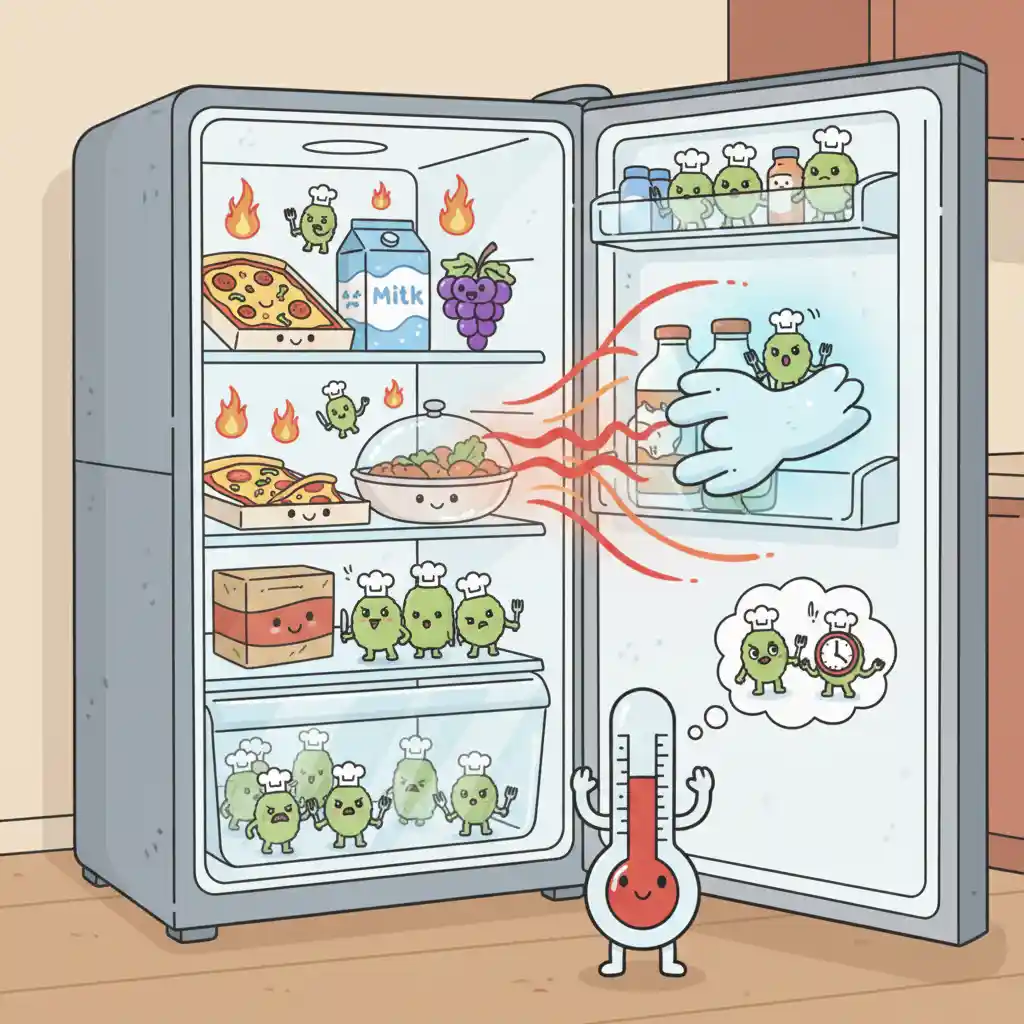
The Great Food Protector
Imagine you've just brought home a delicious pizza or a yummy sandwich from the store. You can't eat it all right away, so where does it go? Into the magical 'Cold Box' – your refrigerator! But have you ever wondered how this amazing appliance keeps your food fresh and prevents it from going bad? It's like having a superhero in your kitchen, fighting off invisible invaders!
Food doesn't just magically 'go bad' on its own. There are tiny, tiny creatures called bacteria and other microscopic helpers called enzymes that love to munch on your food, making it spoil, smell funny, and taste awful. Think of your refrigerator as a secret weapon that slows these tiny invaders down, giving your food a much longer life.
Tiny Tummy Trouble Makers
Let's meet the villains of our story: bacteria and enzymes. These are incredibly small living things that are all around us, even on our food! They're like miniature chefs, constantly working to break down food. When food 'spoils,' it's often because these tiny creatures have multiplied and are feasting on it, changing its flavor, texture, and smell.
These microscopic munchers are super active when it's warm. The warmer it is, the faster they grow and the quicker they can spoil your food. That's why milk goes sour faster on a hot day, and meat spoils if left out on the counter. So, how do we stop them? We don't get rid of them completely, but we make them take a very long, very cold nap!
The Big Chill Secret: It's All About Heat!
Here's a cool secret: a refrigerator doesn't 'add cold' to your food. That might sound strange, but 'cold' isn't really a 'thing' you can add. Instead, cold is just the absence of heat! Think of it like a dark room: you don't 'add darkness,' you just remove the light. A refrigerator's job is to pull the heat out of its box and push it somewhere else.
All matter, including your food and the air around it, contains heat energy. The more heat energy something has, the warmer it feels. By removing this heat energy from inside the fridge, the temperature drops, and everything inside becomes much cooler. This lower temperature is what slows down those busy bacteria and enzymes.
The Amazing Heat-Sucking Machine
So, how does a refrigerator actually pull heat out? It uses a clever system of pipes and a special liquid called 'refrigerant.' Let's imagine a secret loop of pipes running all around your fridge, with a few key players:
- Compressor: This is like the heart of the fridge, usually found at the back or bottom. It's a pump that squeezes the refrigerant, making it very hot and high-pressure.