
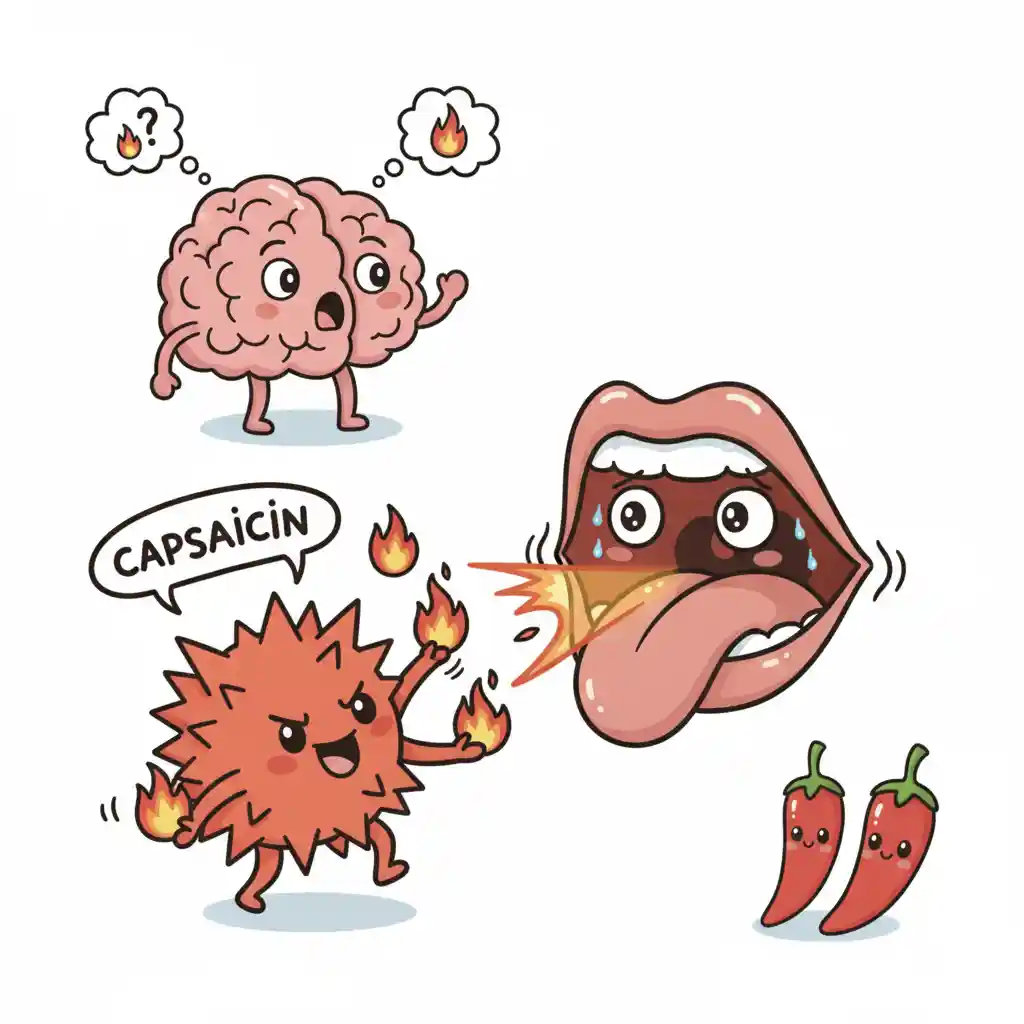
The Mystery of the Mouth on Fire
Have you ever bitten into a chili pepper, and suddenly your mouth feels like it's on fire? It's a strange, tingly, and sometimes even painful sensation. But here's the really wild part: there are no actual flames in your mouth, and the pepper itself isn't hot like a burning stove. So, what exactly is happening to make your tongue feel like a dragon just sneezed on it?
This fiery feeling is one of nature's coolest magic tricks! It's all thanks to a tiny, invisible chemical that plays a huge prank on your brain. It convinces your body that something is scorching hot, even when it’s not. It's like your mouth has its very own alarm system going off because it believes there's an emergency. Let's find out the secret behind this spicy sting!
Meet Capsaicin, the Tricky Chemical
The star of our spicy show is a special chemical called capsaicin (say: cap-SAY-sin). Capsaicin is found mostly in chili peppers, and it's the ingredient responsible for all that spicy heat. It doesn't have a temperature of its own; you could hold a pure bit of capsaicin in your hand, and it wouldn't feel hot at all.
Instead, capsaicin is like a master trickster. It's designed to interact with your body in a very specific way, sending a signal that makes you think you're experiencing heat. It's a chemical messenger that carries a very convincing, but fake, 'hot' message straight to your brain. Think of it as a secret agent whispering directly into your sensory system.
The Great Imposter: How Capsaicin Fools Your Body
Deep inside your mouth, on your tongue, and even in your nose and eyes, you have tiny 'sensors' called receptors. These receptors are like little alarm bells designed to tell your brain what's going on in the world around you. One very important sensor is called TRPV1 (say: trip-VEE-one). Its main job is to detect things that are actually hot, like a sip of very warm cocoa or touching a hot plate.
Here's where capsaicin performs its amazing trick! It's shaped in such a way that it fits perfectly into the TRPV1 sensor, just like a key fits into a lock. When capsaicin plugs into this sensor, it triggers it, making the sensor send an urgent message to your brain: 'DANGER! HOT! FIRE!' Your brain, receiving this signal, can't tell the difference between real heat and the capsaicin trick. So, it reacts as if your mouth is genuinely burning!
Your Body's Fire Alarm & Superpower
Once your brain gets that 'hot' message from the TRPV1 sensors, your body goes into emergency mode! It tries to cool things down. That's why you might start sweating, your nose might run, or your eyes might water – your body is trying to wash away or get rid of the perceived 'heat'.