
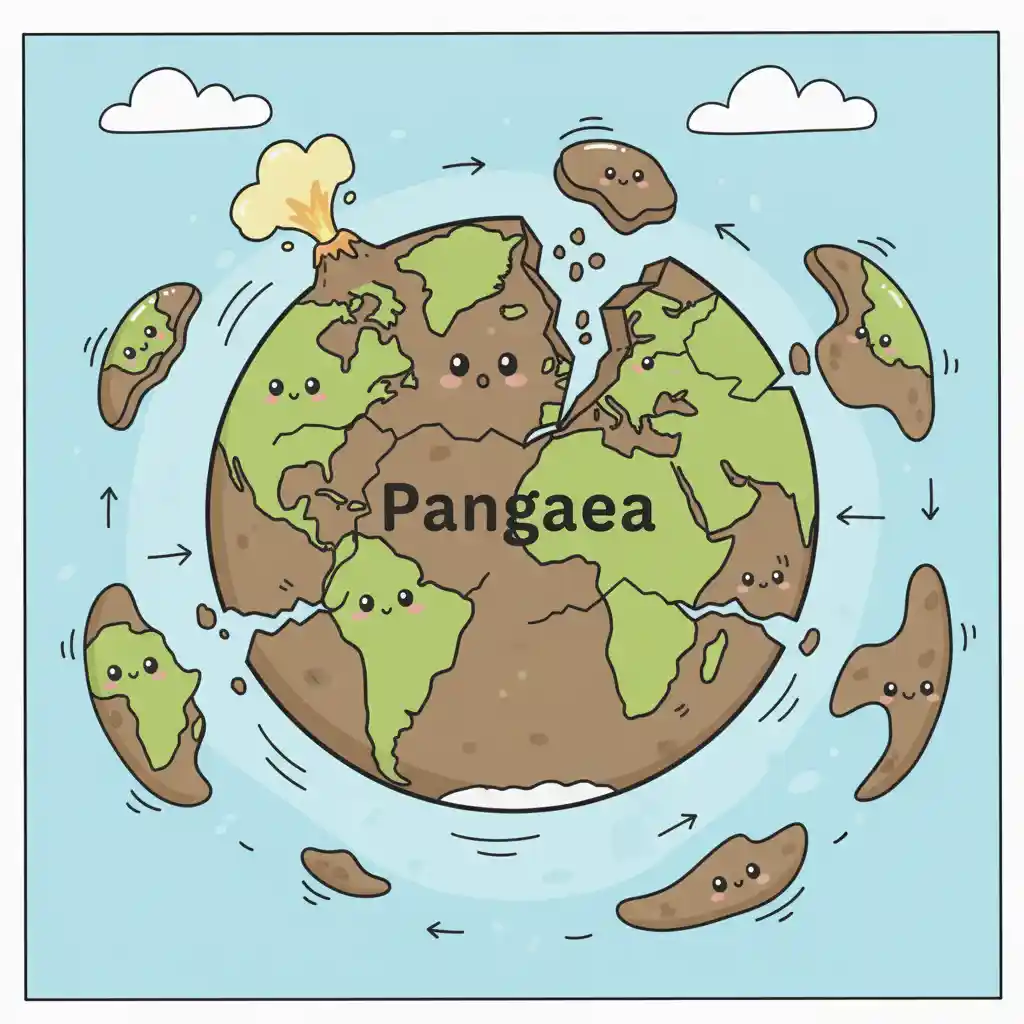
The Giant Jigsaw Puzzle
Imagine a time, about 300 million years ago, when all the continents we know today weren't separate at all! They were all squished together like a giant, super-sized jigsaw puzzle into one enormous landmass. Scientists call this incredible ancient continent 'Pangaea,' which is a Greek word meaning 'all lands.' Think of it: no Atlantic Ocean, no Pacific Ocean separating places like North America and Africa; they were side-by-side!
This colossal continent was a very different world. Animals could walk from what is now Brazil all the way to India without crossing a single ocean! Pangaea existed for millions of years before it slowly began to break apart, creating the continents and oceans we see on our maps today. It's a huge geological mystery, and solving it helps us understand our planet much better.
The Curious Case of Alfred Wegener
For a long time, people thought the continents were fixed in place, like giant, unmoving islands. But then, a brilliant scientist named Alfred Wegener (say: VAY-guh-ner) came along in the early 1900s. He was a meteorologist, which means he studied weather, but he loved looking at maps.
Wegener noticed that the coastlines of continents, especially South America and Africa, looked like they could fit together perfectly, just like puzzle pieces! He also found amazing clues like identical plant and animal fossils (from creatures that couldn't possibly swim across oceans) on different continents that are now thousands of miles apart. People thought his idea of 'continental drift' was wild and laughed at him, but he was onto something huge!
Earth's Inner Furnace and Plate Power
So, how could enormous continents possibly move? Wegener didn't quite have the answer, but later scientists discovered the secret: 'plate tectonics.' Imagine our Earth isn't just one big, solid ball. Instead, its outer shell, called the 'crust,' is broken into about 15-20 enormous pieces, like the cracked shell of a hard-boiled egg. These pieces are called 'tectonic plates.'
These plates aren't sitting still! They're constantly, super-slowly, gliding around on top of a gooey, super-hot layer called the 'mantle.' Think of the mantle like a thick, bubbling stew. Heat from the Earth's very core makes this stew slowly churn and move in giant circles, called 'convection currents.' These currents are like invisible conveyor belts that drag the tectonic plates along with them, causing the continents to drift!