
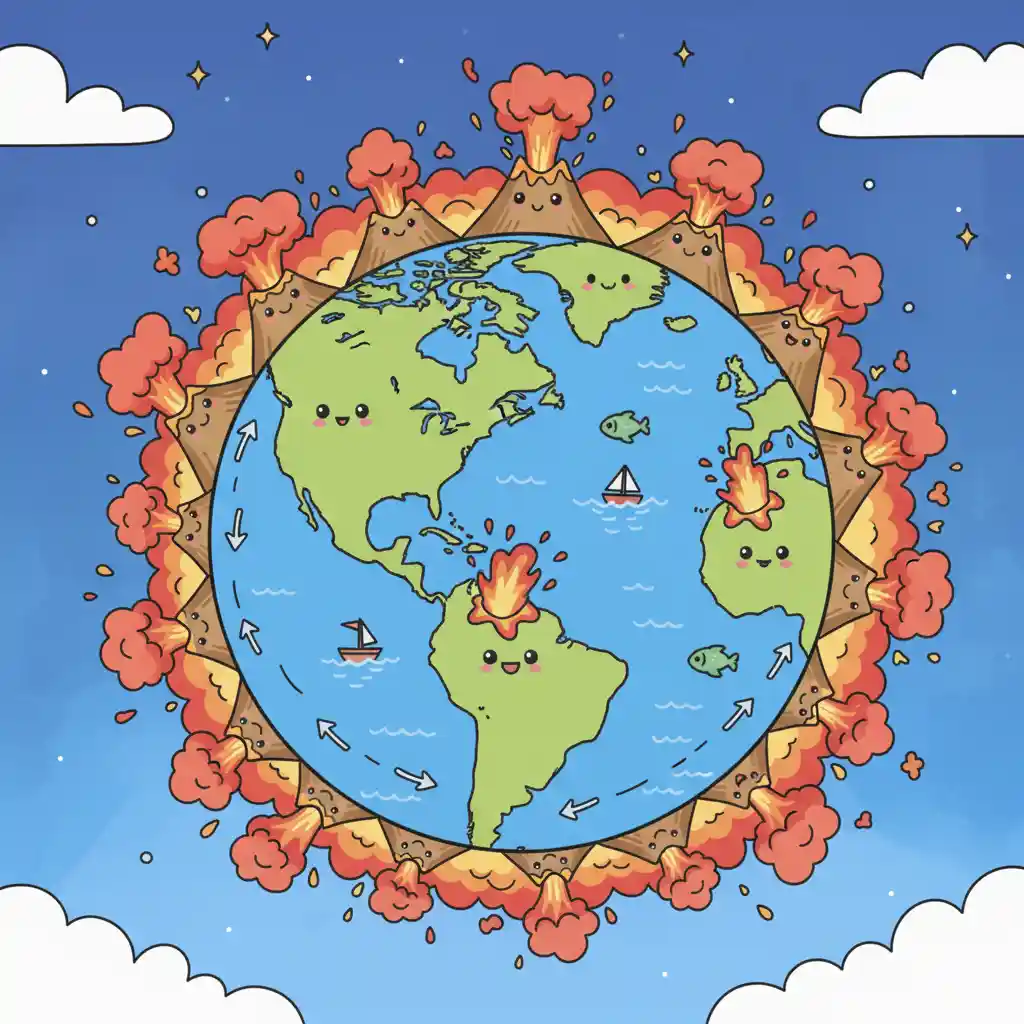
The Fiery Circle: What is the Ring of Fire?
Imagine a giant necklace of volcanoes and earthquake zones, stretching thousands of miles around the Pacific Ocean. This spectacular, but sometimes scary, area is known as the 'Ring of Fire'! It's not a literal ring of flames, but a path where the Earth is constantly rumbling, shaking, and erupting.
It traces the edges of continents like North and South America, Asia, and islands like Japan and Indonesia. If you look at a map, it truly looks like a giant horseshoe or a ring surrounding the vast Pacific. It's where you'll find most of the world's most dramatic geological action, making it a very exciting, and active, place to learn about!
Earth's Giant Jigsaw Puzzle: Tectonic Plates
To understand why the Ring of Fire is so busy, we need to think about Earth's skin. Our planet isn't a smooth, solid ball. Instead, its outer layer, called the crust, is broken into several enormous pieces, much like the pieces of a giant jigsaw puzzle. These massive sections are called 'tectonic plates.'
These plates are not still! They are constantly, albeit very slowly (about as fast as your fingernails grow!), moving and bumping into each other. They slide past each other, pull apart, or crash head-on, floating on a layer of hot, semi-molten rock called the mantle deep inside the Earth. It's like a slow-motion dance party!
Plates on the Move: Where the Action Happens
There are a few ways these massive plates interact. Sometimes they pull apart, letting new material bubble up. Other times, they slide past each other, causing big scrapes. But the most exciting action for the Ring of Fire happens when two plates crash into each other!
Imagine two giant bumper cars slowly, slowly, slowly colliding. When this happens with tectonic plates, one plate often gets pushed underneath the other. This special kind of collision is called a 'convergent boundary,' and it's the secret ingredient for most of the volcanoes in the Ring of Fire.
The Big Dive: Subduction Zones
When an oceanic plate (which is usually thinner and heavier) crashes into a continental plate or another oceanic plate, it's often forced to dive underneath. This incredible process is called 'subduction.' Think of it like a giant conveyor belt, slowly pulling a piece of the Earth's crust down into the hot, gooey mantle.