
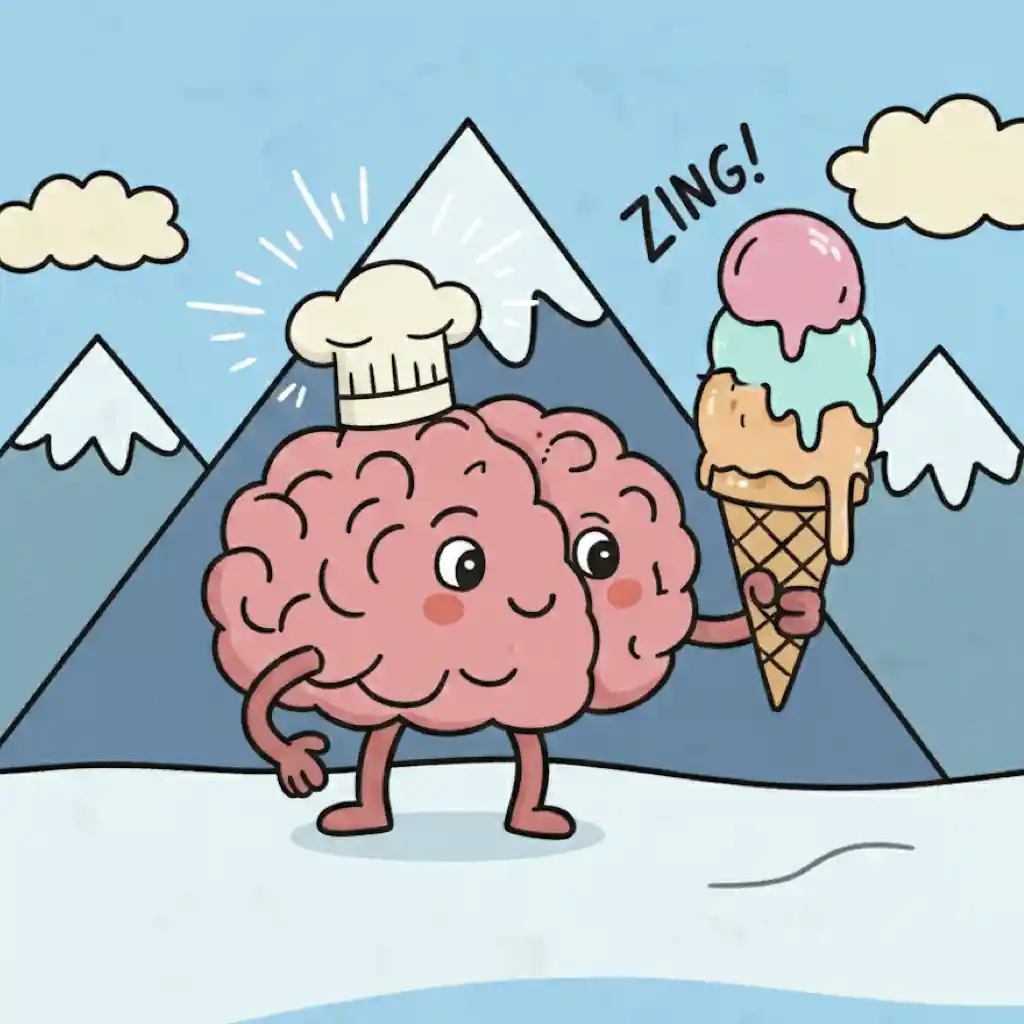
The Roof's Panic Button
When you take a giant bite of a frozen treat, it hits the soft palate at the back of your throat. This area is home to a massive junction of nerves that are highly sensitive to temperature changes.
Because your brain is the most protected organ in your body, these nerves send an immediate 'Emergency Cold' signal to the nervous system, triggering a survival reflex.
The Rapid Warming Glitch
To fight the sudden cold, your brain orders the anterior cerebral arteries to rapidly dilate, or open wide. This is an attempt to flood the area with warm blood to keep your brain's temperature stable.
However, because your skull is a hard bone and cannot expand, this sudden rush of blood creates a temporary spike in pressure, which your brain interprets as a sharp, stabbing pain.
The Trigeminal Nerve Riddle
Have you noticed your forehead hurts even though the ice cream is in your mouth? This is due to the Trigeminal Nerve, the largest nerve in your head. It carries signals from your mouth, jaw, and face.
When the cold signal is too intense, the nerve gets 'overloaded.' The brain gets confused about where the signal is coming from and 'decides' the pain is in your forehead instead of your mouth.
A Lesson in Referred Pain
This phenomenon is called Referred Pain. It happens because different parts of the body share the same 'neural highway' to the brain.
Your forehead isn't actually cold or in danger; it’s simply a victim of a biological cross-wire where the brain mislabels the location of the distress.
The Survival Instinct
Scientists believe this reflex exists to prevent your brain from freezing in extreme environments. By forcing blood to the head quickly, the body ensures that the most vital computer in your body stays online.
Even though it feels like a 'glitch,' it is actually a high-speed safety feature that prioritizes your brain's warmth over your comfort.
The Quick Recovery
As soon as the roof of your mouth warms back up, the blood vessels constrict back to their normal size. The pressure drops, and the Trigeminal nerve calms down.
This is why a brain freeze usually only lasts for 30 to 60 seconds. Once the 'threat' of the cold ice cream is gone, the body resets its internal sensors immediately.
The Tongue Hack
You can actually 'cancel' the brain freeze signal by transferring heat to your soft palate. By pressing your warm tongue against the roof of your mouth, you warm the nerves back up.
This sends a 'False Alarm' signal back to the brain, telling the blood vessels they can stop dilating, which shuts off the pain almost instantly.