
The Physics of Sound
In the dark expanse of the ocean, light fades quickly. To survive, whales have turned to physics. Sound travels nearly five times faster in water than in air and loses energy much more slowly.
Large baleen whales produce 'infrasonic' sounds—notes so low they are below human hearing but carry enough power to vibrate through thousands of miles of water.
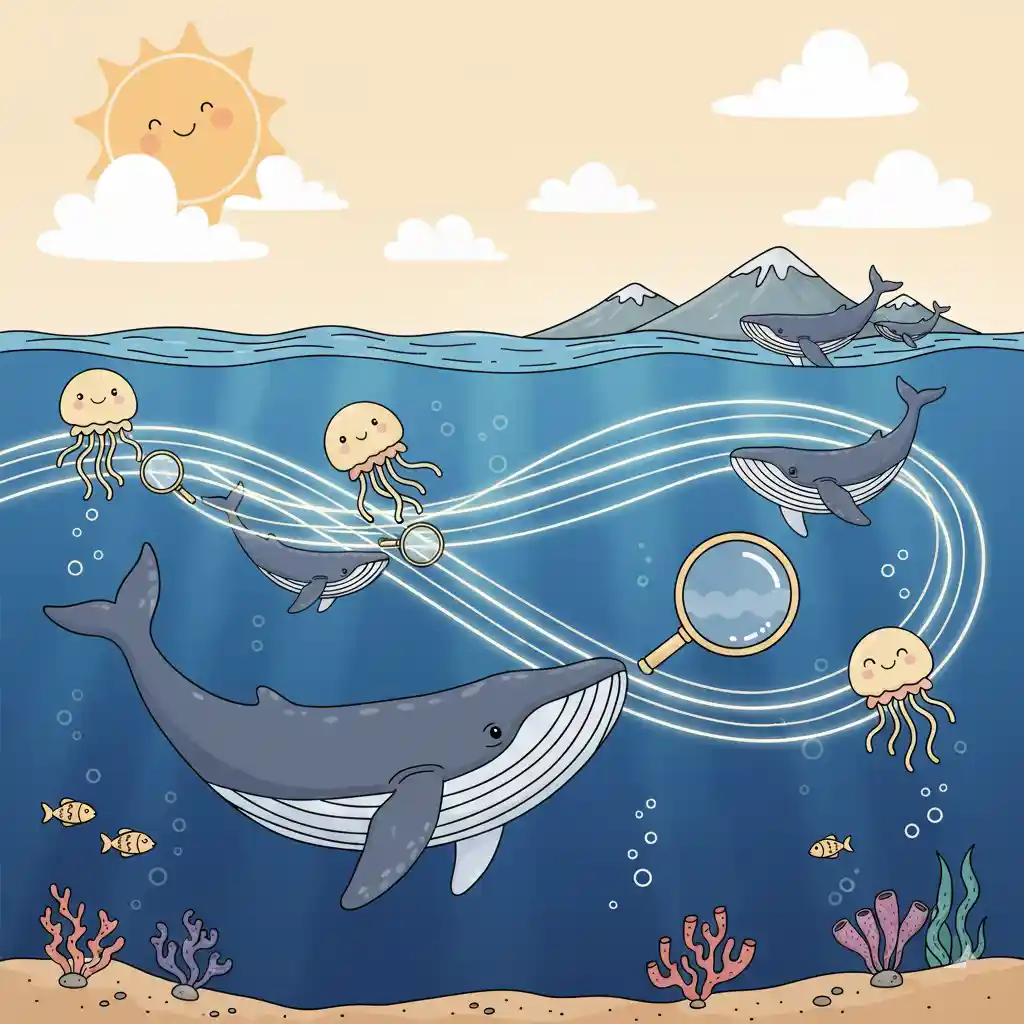
The SOFAR Highway
Deep beneath the waves lies the SOFAR channel. Due to water pressure and temperature, sound waves become trapped in a 'vocal corridor.'
They bounce within this layer like light inside a fiber-optic cable, allowing a whale in the Caribbean to theoretically talk to a friend near Africa.
Cultural Hit Songs
Humpback whales are the pop stars of the sea. All males in a population sing the same complex song, but these songs evolve over time.
If a wandering whale joins the group with a catchy new 'riff,' the other whales will copy it. Scientists have tracked these 'hit songs' as they sweep across the Pacific Ocean.
Seeing with Sound
While some whales sing for social connection, others use sound as a tool. Through echolocation, they emit clicks that bounce off objects.