
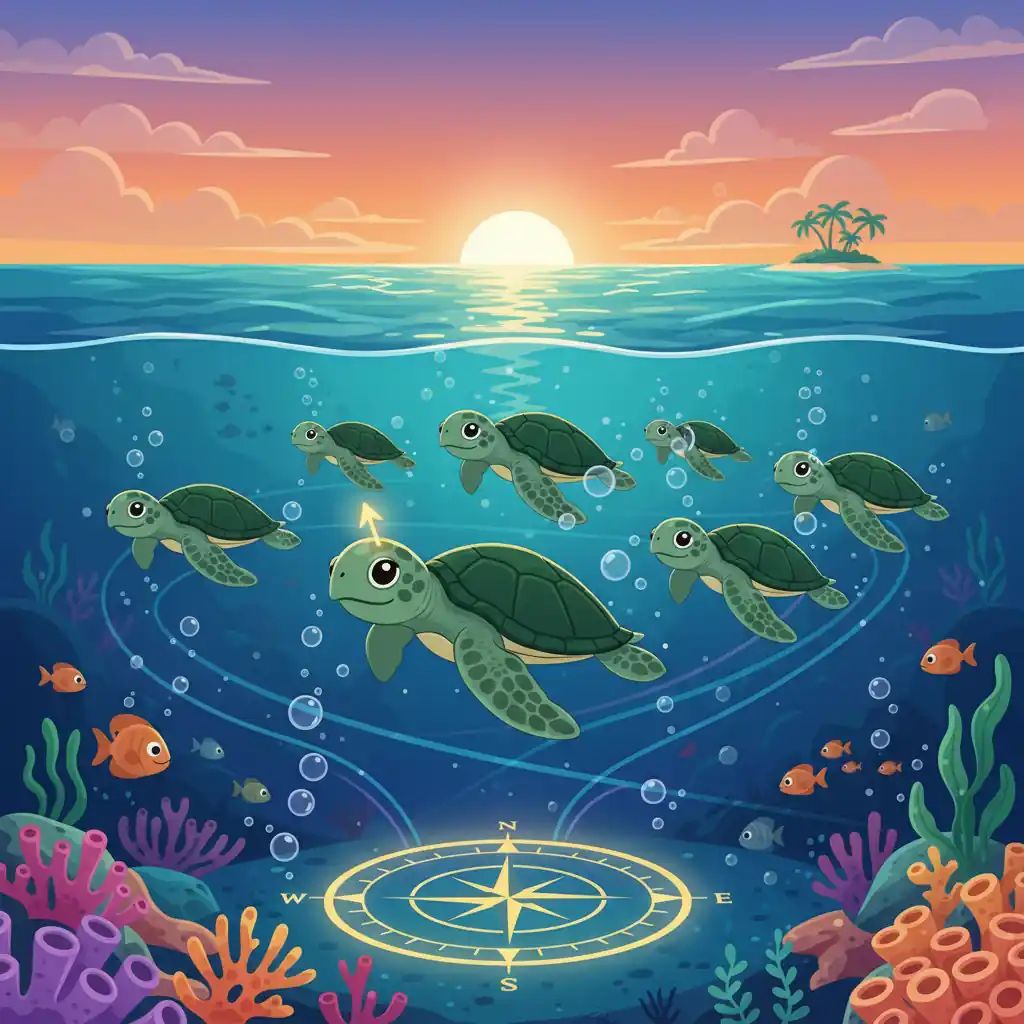
The Tiny Travelers' Great Escape
Imagine you’re a tiny sea turtle, no bigger than your hand, just hatched from a warm, sandy nest on a dark beach. The moonlight is your only guide, sparkling on the waves. You tumble out with your brothers and sisters, all racing towards the ocean, scrambling as fast as your little flippers can carry you. It’s a dangerous dash, with hungry birds and crabs lurking.
Finally, you hit the water! But now what? There are no grown-up turtles to show you the way, no maps, no signs, just an endless, vast ocean stretching out in every direction. How do these brave, tiny adventurers know which way to swim, sometimes for thousands of miles, to find their special nursery grounds where they can grow big and strong?
This isn't just a short trip; it's a journey that can last for years before they return to the same general area as adults to lay their own eggs. The mystery of their incredible navigation has puzzled scientists for a long time, but now we have some amazing clues about their secret 'compass'!
Earth's Invisible Superpower
Our Earth is like a gigantic, invisible bar magnet! It has a North Pole and a South Pole, just like the magnets you play with. These poles create an invisible force field all around our planet, which we call the Earth's magnetic field. Think of it like invisible lines of energy constantly flowing through and around the Earth.
This amazing magnetic field is what makes your compass needle point north, no matter where you are. It’s a superpower that protects us from harmful radiation from space, and it has been guiding creatures on Earth for millions of years. But it’s not just a simple 'north or south' guide for our sea turtles.
What’s really clever is that this magnetic field isn't flat. It angles differently depending on where you are on Earth – it’s steeper near the poles and flatter near the equator. Also, the strength of this magnetic pull changes! It’s weaker in some places and stronger in others. These tiny differences are super important for our turtle friends.
A Built-In Compass in Their Head
So, how do baby turtles 'feel' this invisible magnetic field? They don't have little compasses strapped to their heads! Scientists believe they have special, super-sensitive cells inside their bodies, possibly in their brains or even their eyes, that can detect these magnetic lines of force. It’s a bit like how we feel hot or cold, but for magnetism!
This incredible ability is called 'magnetoreception,' and it's like having a built-in GPS that’s always turned on. Their bodies can tell not only which way is north or south, but also how strong the Earth's magnetic 'hug' is in that spot and how steeply the invisible magnetic lines are pointing up or down. Imagine if you could feel the invisible forces of the Earth!
Because they can sense both the 'intensity' (strength) and 'inclination' (angle) of the magnetic field, they get a lot more information than just a simple direction. It’s like having two different dials, each giving a piece of information, that together tell them exactly where they are on the planet.