
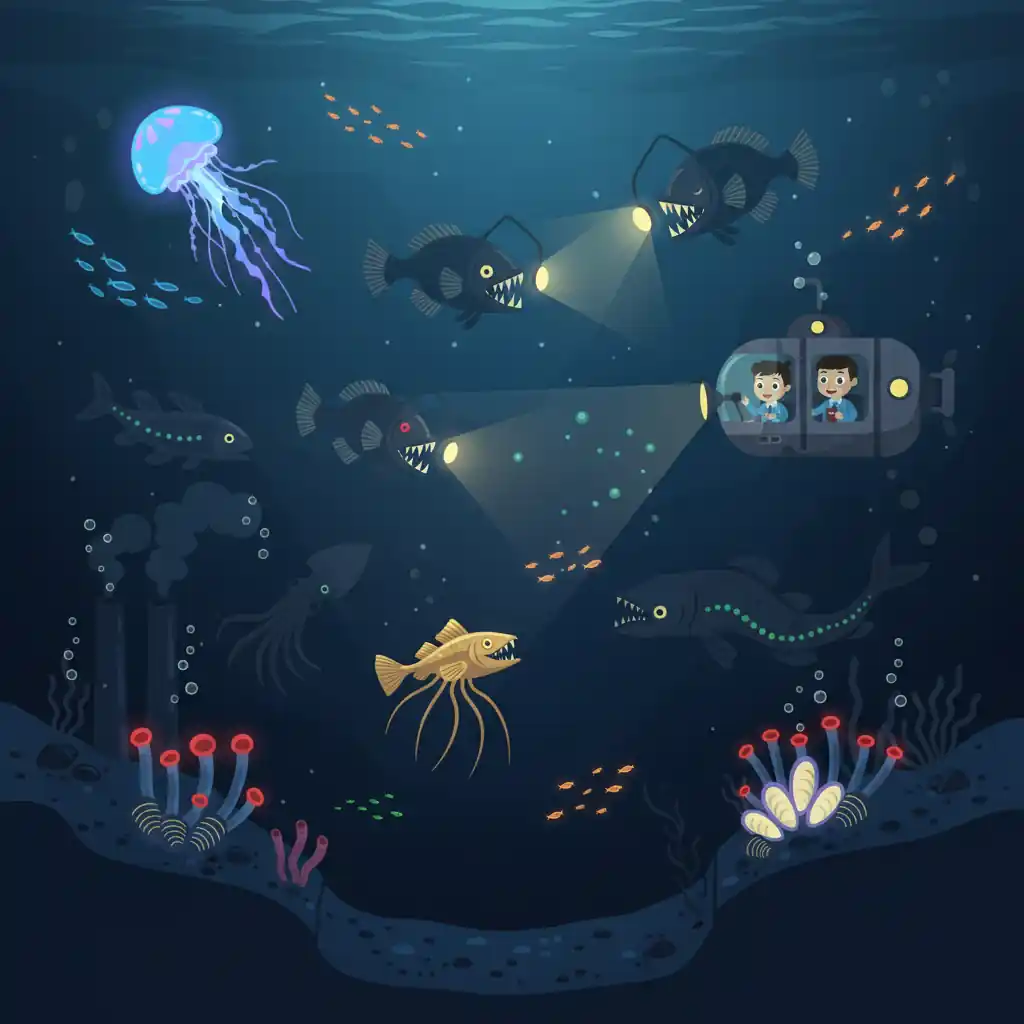
Welcome to the Midnight Zone!
Imagine a place where the sun never shines, a world wrapped in eternal night. This isn't a dark closet; it's the deep ocean! Down in the trenches, miles below the surface, sunlight can't reach. It's colder than your freezer and the pressure is so great it would squash a car flat. You might think this place would be totally empty and boring, but guess what? It's actually bursting with life... and light!
How can there be light in a place where the sun's rays can't pierce through? The incredible secret is that many creatures living in this 'midnight zone' make their very own light! This amazing ability is called 'bioluminescence,' which literally means 'living light.' It's like every fish and squid down there carries its own tiny, magical flashlight. But why do they glow, and how do they do it?
From tiny glowing plankton to massive, mysterious sharks, bioluminescence is everywhere in the deep. It's not just a pretty show; it's essential for survival. So, get ready to dive deep with us and uncover the glowing secrets of the ocean's darkest corners. Prepare to be amazed by creatures that light up their world in ways we can only dream of!
The Magic Recipe: How Animals Make Their Own Light
Making light isn't magic, it's science! Unlike a lightbulb that needs electricity or a fire that needs heat, bioluminescence is a 'cold light.' This means it creates light without producing much heat at all. If you touch a lightbulb, it's hot, right? But if you could touch a glowing deep-sea creature, it would feel cool. Pretty neat, huh?
So, what's the secret recipe? It usually involves two special ingredients: a chemical called 'luciferin' (think of it as the fuel) and an enzyme called 'luciferase' (think of it as the match). When these two mix with oxygen from the water, they create a chemical reaction that releases energy in the form of light! Some animals produce these chemicals themselves, while others have tiny, glowing bacteria living inside them that do the job.
Imagine having a little chemical factory inside your body that you can switch on and off to create light whenever you need it! The most common color of bioluminescence in the deep ocean is blue or green. This is because blue light travels furthest in water, making it perfect for signaling across vast distances in the dark depths.
Luring and Trapping: Glow for the Munchies!
One of the coolest ways deep-sea creatures use their glow is for hunting. Imagine being a hungry fish in the pitch black. How do you find your next meal? You turn on a lure! The famous Anglerfish, for example, has a long 'fishing rod' growing out of its head with a glowing bait at the end. It dangles this light right in front of its huge, sharp-toothed mouth.
Curious little fish, attracted by the shimmering light, swim closer, thinking they've found a tasty snack or another friendly glowing creature. But surprise! When they get close enough, the Anglerfish snaps its jaws shut, and dinner is served! It's like having a built-in trap right on your face.
Other creatures, like certain squids, use flashes of light to stun or confuse their prey, making them easier to catch. Some even mimic tiny glowing plankton to attract bigger fish, only to gobble them up! In the deep sea, being able to create your own light means you don't have to wait for food to come to you; you can literally 'light up' your dinner.