
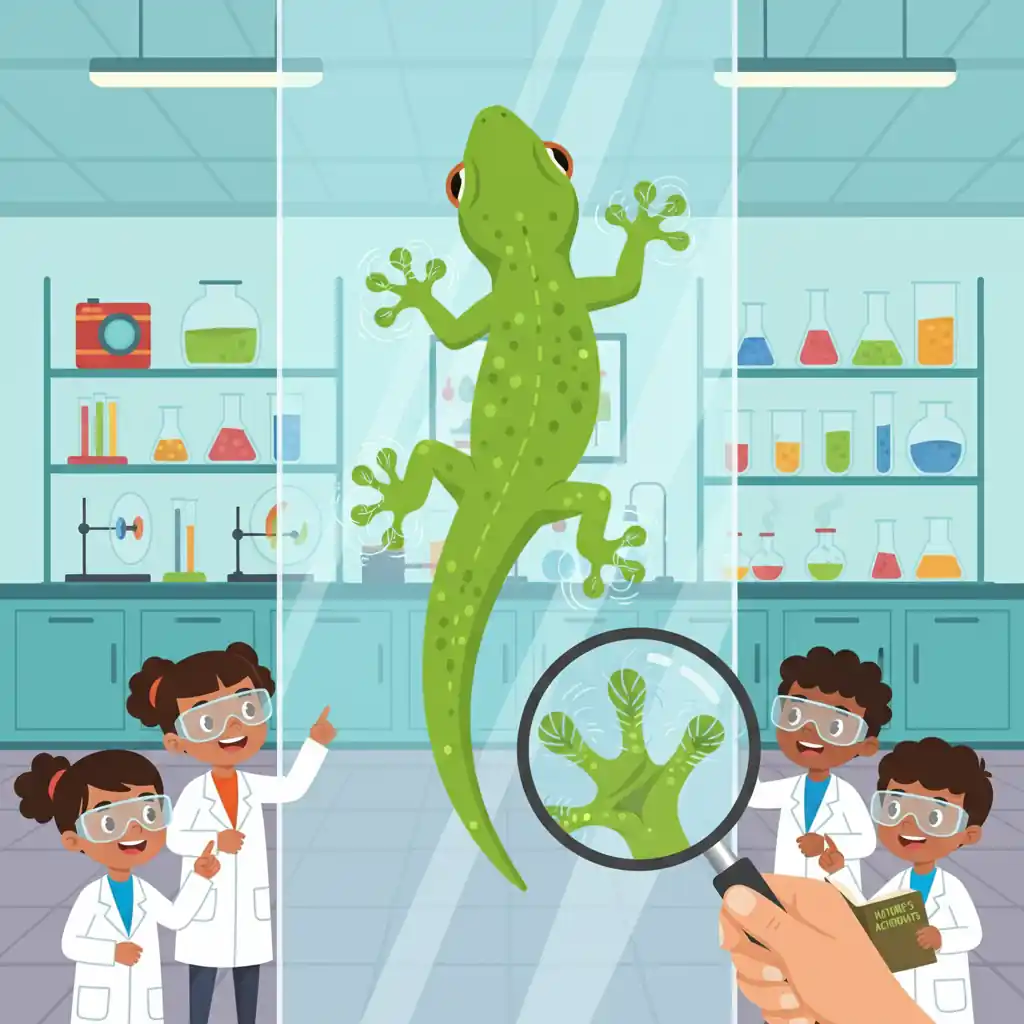
Gecko Superpowers!
Imagine being able to walk straight up a wall, scamper across the ceiling like it's flat ground, or even hang upside down from a super-smooth pane of glass without breaking a sweat! Sounds like something straight out of a superhero comic book, right? Well, there's a real-life superhero that does all of this with incredible ease every single day: the amazing gecko! These fascinating little lizards, often found darting around in warm parts of the world, possess one of nature's coolest and most perplexing tricks up their sleeves—or rather, on their specialized feet! Their incredible sticking power isn't magic, and it certainly isn't messy glue; it's pure, ingenious science, and understanding it is way more fascinating than any sticky tape could ever be. It allows them to navigate nearly any surface with astonishing agility, making them master climbers of the animal kingdom.
It's Not Glue, It's Science!
When you think of something sticky, your mind probably jumps to messy school glue, super-strong epoxy, or the adhesive on a roll of tape, which usually leaves a residue or feels gooey to the touch. But geckos don't have gooey feet at all, and they certainly don't leave any tell-tale marks or sticky footprints when they scurry across a window and then dart away! So, for a long time, scientists were incredibly puzzled. How could these small creatures defy gravity on such smooth surfaces without any obvious adhesive? They knew geckos had special feet, distinct from other lizards, but understanding the precise how was a tricky scientific puzzle. It turns out, their secret isn't a powerful, liquid adhesive, but rather an invisible, microscopic force that works on a super tiny, atomic level. It’s like having billions of tiny, invisible hands working together in perfect harmony.
Millions of Tiny Hairs (Setae)
If you were to peek at a gecko’s foot under a super-powerful microscope, the kind that lets you see things thousands of times smaller than what your eyes can detect, you wouldn't see smooth, ordinary lizard skin. Instead, you'd be absolutely amazed by what looks like a ridiculously dense, microscopic furry carpet! Each of a gecko's five toes is covered with a mind-boggling number of tiny, bristle-like structures. These aren't just any hairs; they are specialized hair-like structures called "setae" (pronounced SEE-tay). To give you an idea of their incredible fineness, a single human hair, which is already quite thin, is actually wider than about 10 of these individual gecko setae put together! The sheer volume and density of these millions of tiny hairs create an enormous amount of surface area, which is the first big clue to their amazing sticking power.
Even Tinier Hairs (Spatulae) and Van der Waals Forces
But wait, the incredible design of a gecko's foot doesn't stop there; it gets even more intricate and astonishing! Each one of those millions of setae, those fine hair-like structures, doesn't just end in a simple point. Instead, each seta branches out even further, fanning out into hundreds, and sometimes even thousands, of even tinier, flatter, paddle-shaped tips. These microscopic tips are appropriately called "spatulae" (pronounced SPAT-yoo-lie) because, when viewed under extremely high magnification, they truly do resemble miniature kitchen spatulas. Imagine a tree, but instead of leaves, each tiny branch ends with a flat, paddle-like tip, all designed for maximum contact. It's these spatulae, the very tips of these ultra-fine hairs, that come into incredibly close, intimate contact with any surface the gecko walks on. And that, my friends, is precisely where the real sticking magic happens, thanks to an invisible but powerful phenomenon known as "van der Waals forces."