
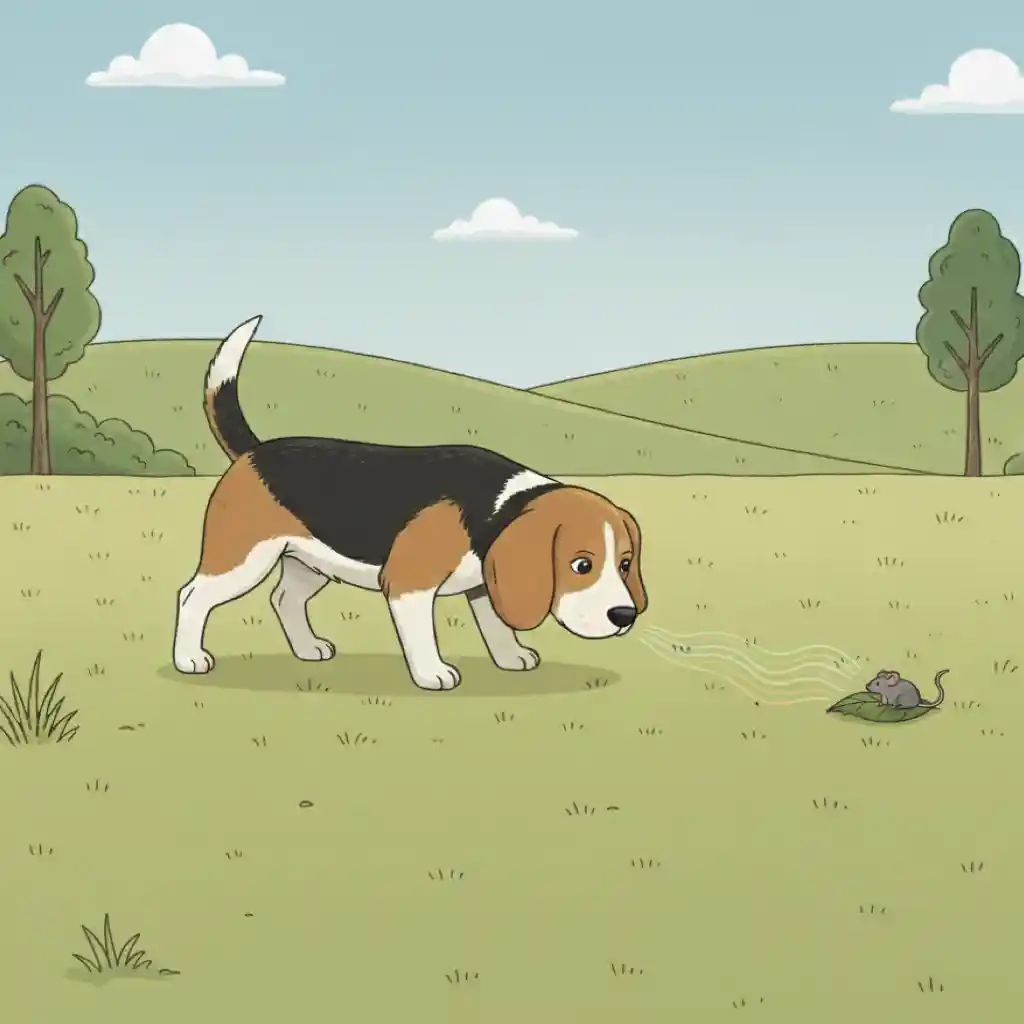
The Stereo Sniffer
Imagine walking into a room and not just smelling 'coffee,' but smelling the specific beans, the roast level, and even the mineral content of the water used. Dogs smell in 3D. Because their nostrils can move independently, they capture air at slightly different times.
Their brain compares these two signals to pinpoint exactly which direction a scent is coming from, much like how humans use two ears to find the source of a sound.
A Second Smell Organ
Beneath the main nasal passage lies a secret sensor: the Jacobson's organ. This tool is dedicated to pheromones—chemical signals that act like a bio-social network. When a dog curls its lip or 'tastes' the air, it's sending these signals directly to this organ.
It tells the dog if another animal is friendly, sick, or even what they ate for lunch. It is an emotional sensor that functions entirely separately from their regular sense of smell.
The Dual-Track Breathing System
Humans have a major design flaw: we can't smell well while we exhale because the air pushes scents away. Dogs have evolved a 'dual-track' system. A specialized flap of tissue splits inhaled air—part goes to the lungs for breathing, and the rest goes to a specialized area packed with 300 million scent receptors.
When the dog exhales, the air leaves through the side slits of the nose, creating a swirl that actually pulls new scent molecules in, allowing for a continuous, uninterrupted stream of information.
A Smell Time-Machine
To a dog, a lamppost is a historical archive. Because scent molecules linger at different rates, a dog can tell who was there an hour ago (the past) and which way they were moving (the future).
This 'smell-vision' builds a map of the neighborhood that is invisible to us. They aren't just seeing the world as it is; they are reading it as a chronological story written in chemicals.
The Wet Nose Advantage
Ever wonder why a dog's nose is usually wet? That layer of mucus isn't just for show; it serves a vital purpose. The moisture helps capture tiny scent particles from the air, 'trapping' them so the dog can analyze them.
By licking their noses, dogs can actually move these captured particles toward the roof of the mouth to further stimulate the Jacobson's organ, ensuring no chemical data is lost.
Detecting the Invisible
A dog's nose is sensitive enough to detect things that haven't even happened yet. They can sense the tiny drop in air pressure and the change in ozone that precedes a thunderstorm.
More impressively, they can detect the subtle shift in human volatile organic compounds (VOCs) that occur before a person experiences a seizure or a drop in blood sugar, acting as a living medical alarm system.
The Brain's Smell Center
The part of a dog's brain that processes smells is about 40 times larger than ours relative to total brain size. This allows them to remember thousands of individual scents for their entire lives.
While a human might remember a face, a dog remembers the specific chemical 'signature' of a friend they haven't seen in years, making their memory a library of aromas.