
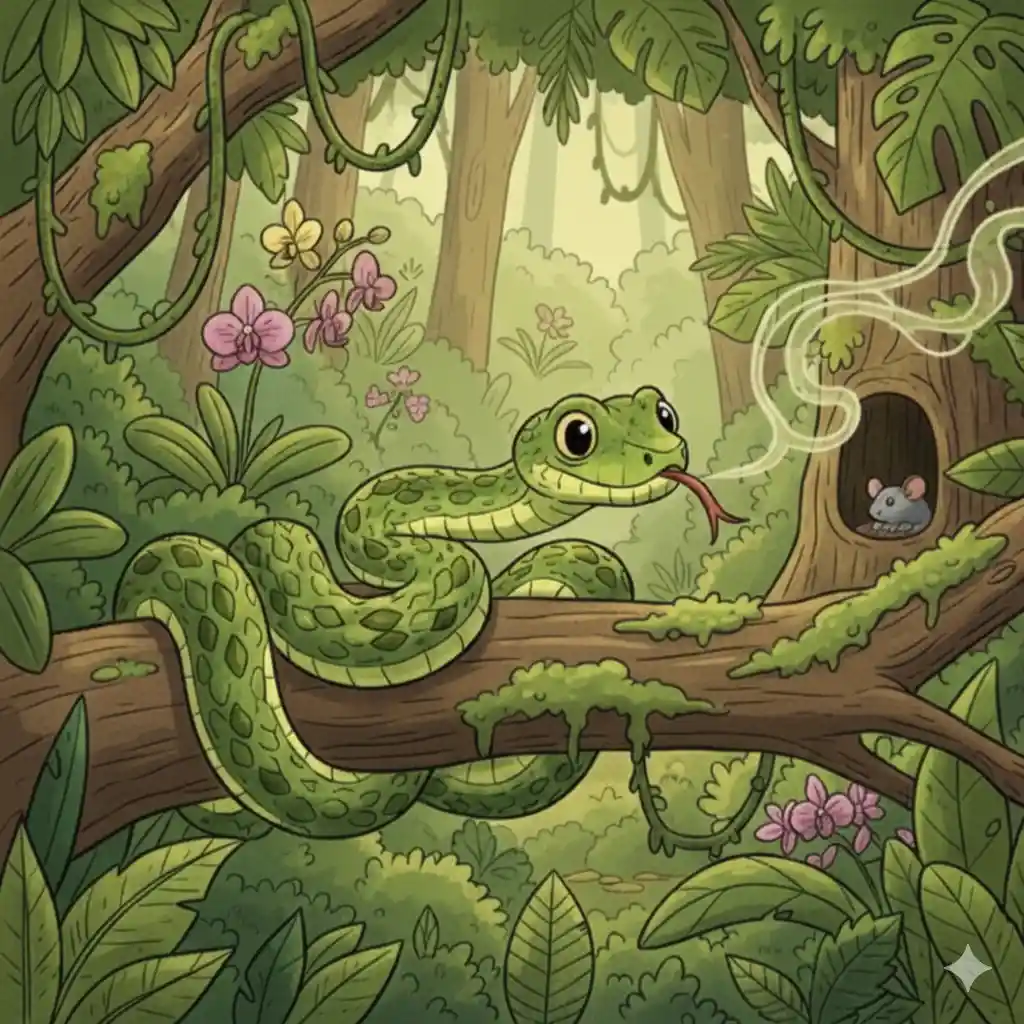
Tasting the Air
A snake's tongue isn't for tasting food; it's for gathering data. When a snake flicks its tongue, it is picking up microscopic scent particles and moisture from the air.
They are solving the riddle of navigation in a world where they are low to the ground and can't see over the grass. The tongue is their primary tool for 'mapping' the environment.
The Jacobson’s Organ
The magic happens when the tongue pulls back inside the mouth. The two tips fit into two tiny holes in the roof of the mouth called the Jacobson’s organ (or the vomeronasal organ).
This organ processes the chemical particles and sends a massive report to the brain. It's like a high-speed chemical scanner that tells the snake exactly what is nearby—from a mouse to a puddle of water.
The Forked Advantage
Why is the tongue split? It's for stereo smelling. Because the tips are apart, the snake can detect if a scent is stronger on the left or the right side.
This allows them to follow a scent trail like a professional tracker. By comparing the 'data' from each tip, the snake knows exactly which direction to turn to find its prey or avoid a predator.
The Silent Radar
This system is completely silent. Unlike a mammal that has to sniff loudly, a snake can gather information without making a sound. This makes them the ultimate stealth hunters.