
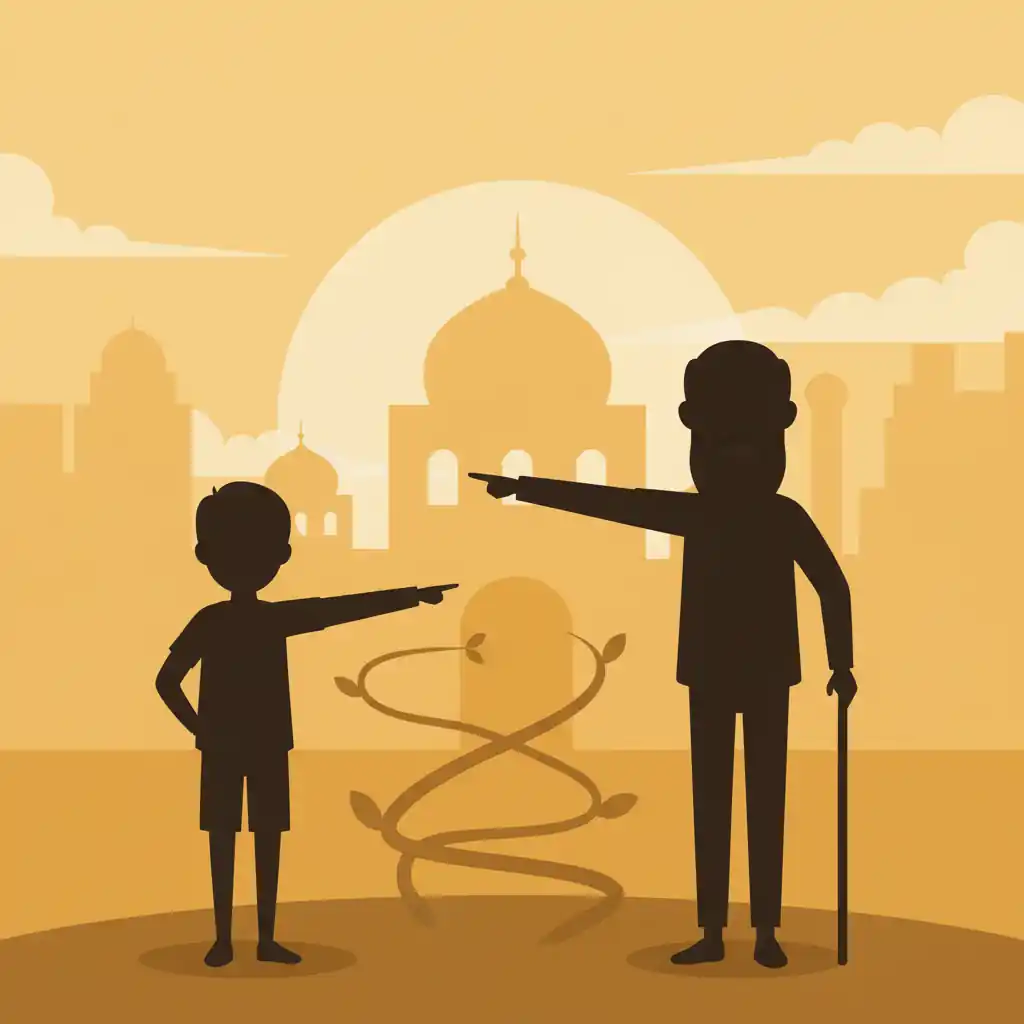
The Young Tree and the Gardener's Choice
In the ancient city of Damascus, a place famed for its vibrant markets and grand gardens, lived a wise old gardener named Abu Fares.
He spent his days caring for the magnificent olive groves and fragrant rose bushes of a wealthy merchant.
One spring morning, during his usual rounds, Abu Fares noticed a young fig sapling growing near the old stone wall.
It was barely thicker than his thumb. But it was already leaning.
Not straight up towards the sun, but bent sharply towards the wall, seeking light from an odd angle.
Abu Fares paused. He could easily straighten it. A simple stake, a piece of twine. The task would take less than a minute.
He frowned. He had many chores that day. The roses needed trimming. The irrigation channels were clogged.
"It's just a little bend," he muttered to himself. "It will find its way eventually."
He decided to leave it. A small, insignificant thing. He had bigger gardens to manage.
The Old Tree and Fixed Nature
Years turned into decades. The merchant grew old. Abu Fares, too, felt the ache in his bones with each passing season.
But the garden continued to flourish.
And that little fig sapling near the wall? It had grown into a giant.
Its trunk was now as thick as a man's waist, its branches spreading wide, heavy with sweet fruit.
Yet, it remained bent.
The initial lean, once so slight, was now a permanent, unyielding curve.
Its massive trunk twisted sharply, still angled towards the very spot where it first sought light against the stone wall.
Its roots were deep, anchoring it firmly in its crooked position.
Abu Fares often sat beneath its shade, drinking mint tea. He looked at the tree, and a pang of regret always pricked him.
He could have straightened it. So easily, then.
Now, to try and force it straight, to change its direction, would be impossible. The trunk would snap. The roots would tear.
The tree was fixed in its nature, shaped forever by its earliest days.
The Roots of Human Habit
Abu Fares watched his grandchildren play in the shade of that same bent fig tree.
He saw his youngest grandson, Omar, always sharing his dates, even the last one. Always honest, even about a broken clay pot.
And he observed his elder granddaughter, Layla, who, if left alone, would sneak a sweet fig before dinner, then deny it with wide, innocent eyes.
He remembered the tree.
"Ya Omar," he would often say, "you are building a straight, strong trunk."
"And Layla," he often thought with a sigh, "if you always take what is not yours, even small things, how will your trunk grow?"
He knew the truth. A child who learns to speak kindly grows into an elder whose words soothe and inspire.