
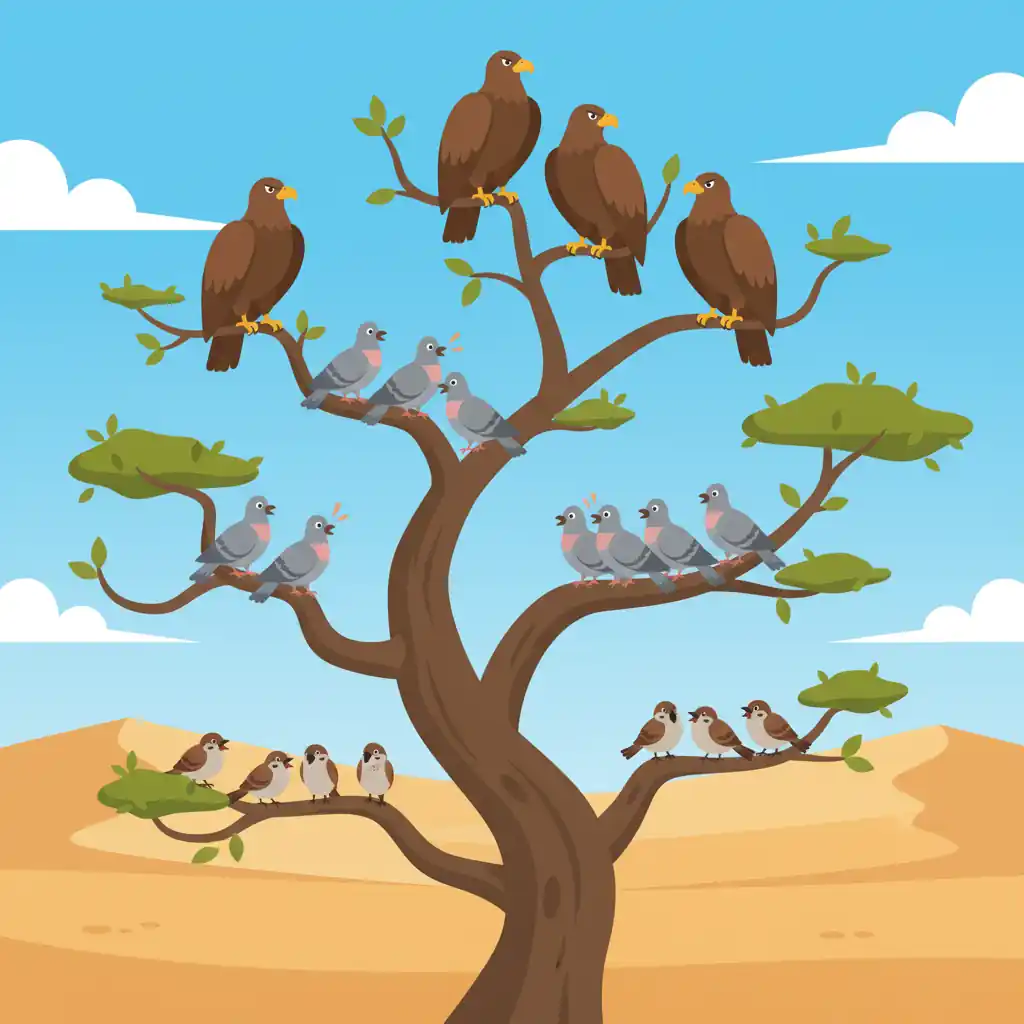
The Sky Watcher
In a land of dry plains and clear blue skies, lived a shepherd named Rashid. His days were long. His company was his flock of sheep and the vast, open horizon.
Rashid spent hours watching the sky. He saw eagles soar on high currents. He saw sparrows dart among the low bushes. He saw pigeons gather on village rooftops. And he saw hawks circling above, always alone.
He noticed something simple, yet profound. Eagles, magnificent hunters, never flew with the tiny, chirping sparrows. Pigeons, plump and gentle, kept their distance from the sharp-taloned hawks.
It was never an eagle joining a flock of pigeons. It was never a sparrow trying to keep pace with a swift hawk. Each bird, without fail, found its own kind.
They flew together. They landed together. They rested together. Always birds of the same feather.
Rashid observed this daily. It was a silent rule of nature. A law written in the very air above him.
The Logic of Nature
Rashid understood why. An eagle flew fast. Its eyes saw prey from miles away. It hunted alone, a powerful predator.
A sparrow flew in quick bursts. It fed on seeds and crumbs. Its safety lay in numbers, a small bird easily overlooked in a group.
A pigeon's flight was steady. Its diet was grain. It needed its flock for protection and shared vigilance against danger.
Their speeds were different. Their meals were different. Their dangers were different. Their very natures were different.
To fly with a different kind would be foolish. An eagle would slow down a sparrow. A sparrow would only be a burden to an eagle. They wouldn't understand each other's needs. They couldn't survive together.
It was not a matter of choice alone. It was a matter of survival. Birds, by instinct, sought out those who shared their characteristics, their way of life, and their destiny.
The Human Mirror
One day, as Rashid led his flock near the village, his eyes fell upon the people gathered there. The bustling marketplace was a tapestry of human interaction.
He saw the poets. They sat under the shade of a large fig tree, reciting verses. Their voices were soft, their gestures expressive. They shared stories, laughing at shared jokes, discussing the beauty of words. Only poets sat with poets.
He saw the merchants. They stood by their stalls, their voices loud, their hands counting coins. They spoke of trade routes and prices, of bargains made and profits gained. Only merchants gathered with merchants.
He saw a group of men in a dimly lit corner. Their faces were shadowed, their voices low. They exchanged hurried whispers, their eyes darting around. These were the village rogues, the ones who bent rules or broke them. Only thieves whispered with thieves.