
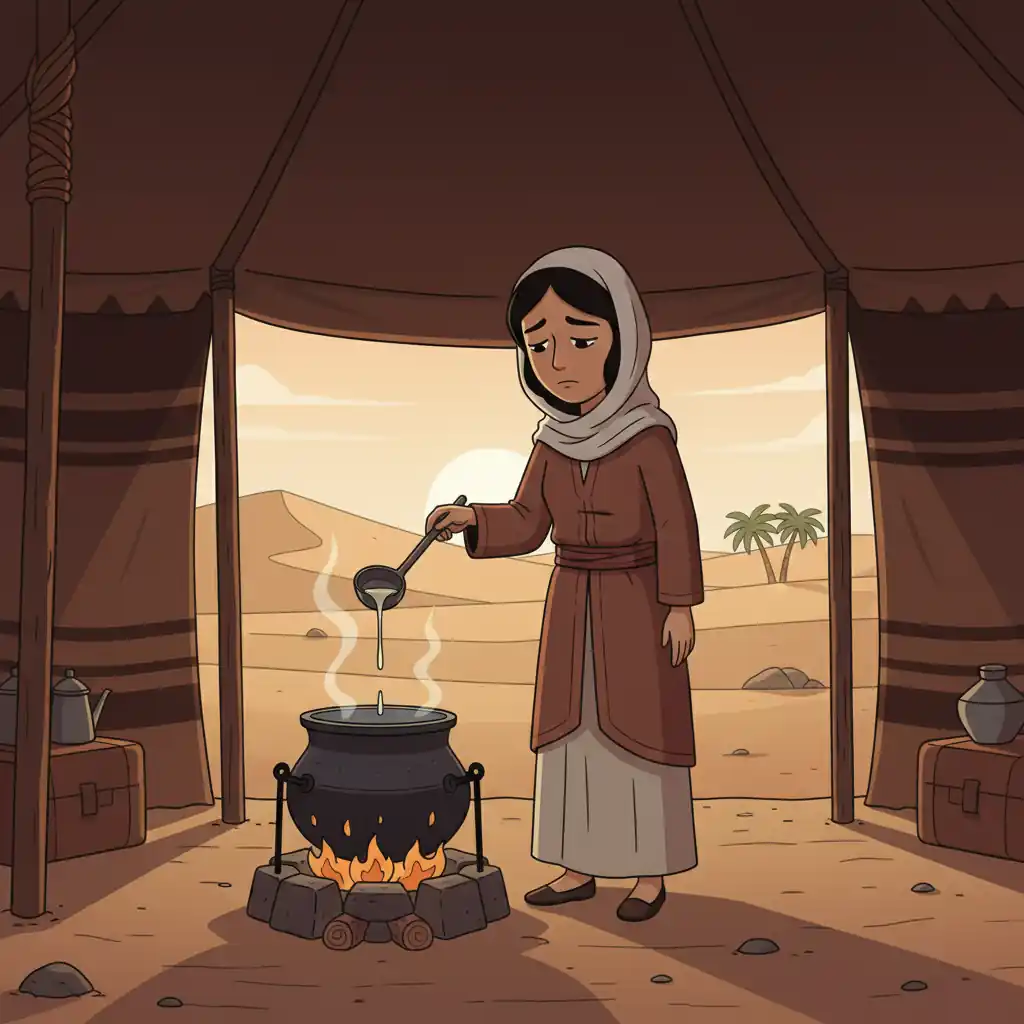
The Generous Hatim al-Tai and His Frugal Wife
Hatim al-Tai was a legend. His name echoed across the desert. Everyone knew him for one thing: his generosity. He opened his tent to all. Guests arrived daily, sometimes by the dozens. He never turned anyone away.
Hatim loved to host. He loved to share. His table was always laden with food, his hearth always warm.
But Hatim had a problem. Not with his guests, but with his wife, Halima. She was not like him. Halima was famously frugal. Some might say stingy. Her great love was not for sharing, but for saving. Especially when it came to cooking oil.
When guests arrived, Hatim would call for a lavish meal. Halima would sigh. She would measure out oil with a miserly hand, a few drops at a time. Her food, though cooked, often lacked the richness expected from Hatim’s household. It was always a point of quiet contention between them.
The Secret of Long Life
Hatim grew tired of the dry food. He grew tired of Halima’s tight grip on the oil jug. He needed a plan. A clever one.
One evening, as Halima prepared a small pot of lentils, Hatim approached her. He spoke in a low, conspiratorial voice. “Halima,” he began, “do you know the secret of long life?”
Halima stopped stirring. Her ears perked up. She valued health and longevity above almost everything. “No, my lord,” she said. “Tell me.”
Hatim leaned closer. “The ancients believed a secret. For every spoonful of oil you add to the cooking pot, a day is added to your life.” He nodded gravely, as if sharing forbidden knowledge.
Halima’s eyes widened. Her mind raced. Days of life! This was a treasure greater than any gold. Her stinginess vanished, replaced by an urgent desire to live longer.
From that day on, Halima became the most generous cook in the land. She poured oil into every dish, not by spoonfuls, but by ladles. The lentils swam in it. The meat glistened. Her dishes became legendary for their richness, a stark contrast to her old ways.
Hatim smiled. His guests were happy. Halima believed she was adding years to her life with every splash of oil. Everyone benefited. For a time, peace reigned in the kitchen.
A Shadow Falls
Years passed. Halima continued her oil-rich cooking, secure in the belief that she was guaranteeing a long future. She often spoke of her secret, much to Hatim’s quiet amusement.
Then, tragedy struck. Halima’s beloved young son fell ill. His sickness was swift and brutal. Despite all prayers and efforts, he died. He was her heart, her joy.
Halima was crushed. Her grief was immense, unbearable. The light left her eyes. She no longer wished for a long life. In her despair, she longed for her own end, to join her son.
She remembered Hatim’s old 'secret.' If oil added days, then surely less oil would shorten them. A grim determination set in.
The very next day, Halima returned to the kitchen. Her hands, once so liberal with oil, now trembled as she measured. She used the barest minimum. A few drops, just enough to prevent burning. Her meals became dry. Tasteless. They were a reflection of her broken spirit, and her desperate wish for an early end.
The Old Habit Returns
The change in Halima’s cooking was immediate and striking. The rich, oily dishes vanished. The food was once again bland, almost inedible. The guests noticed. The servants whispered.
Hatim watched his grieving wife, his heart heavy. He understood her silent plea. He knew the source of her renewed frugality.
The neighbors, remembering Halima's long-abandoned ways, began to remark. “Look,” one would say to another, “Halima has returned to her old habit.” Another would nod gravely. “Indeed. Her hands are as tight with the oil as before.”
The phrase spread quickly through the household and beyond. It was a simple observation, born of personal tragedy and a well-known peculiarity. Halima, in her despair, had reverted to her most ingrained nature.
The Enduring Saying
Over time, the tragic story of Halima and her oil became a common saying. It moved beyond a specific person and a specific tragedy. It became a universal truth.
Whenever someone reverted to an old, undesirable behavior after a period of change or improvement, people would remember Halima. A lazy student who suddenly started studying, then stopped. A reformed gambler who returned to the tables. A stingy person who briefly became generous.
People would shake their heads and say, “رجعت حليمة لعادتها القديمة.”
It means that old habits die hard. That true nature, despite attempts at change, often reasserts itself, especially under stress or in moments of weakness.
- رجعت (Raja’at): Returned / She returned.
- حليمة (Halima): Halima (a proper female name).
- لعادتها (Li-‘adatiha): To her habit / To her custom.
- القديمة (Al-qadeemah): The old (feminine singular).
Literally, the phrase means: “Halima has returned to her old habit.”
This idiom teaches us that while people can change their behavior, core habits and dispositions are deeply ingrained. Often, under pressure or emotional duress, individuals may revert to their fundamental nature, proving that old habits are incredibly difficult to break entirely.